Digital SAT Exam Prep

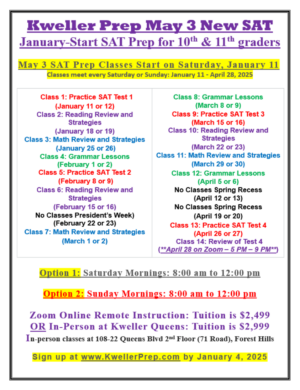
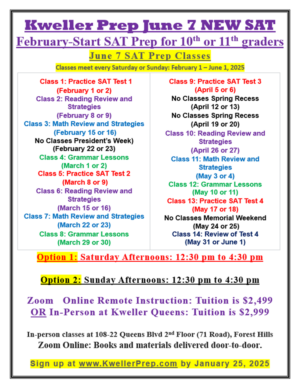
Signup For Your D-SAT Course

Select a course below, select your preferred session type and class schedule. You will be guided through the checkout process.

Important Notes About the D-SAT Exam

  1. The SAT is fully digital. All students — in the U.S. and internationally — have taken the SAT on a computer since March 2024. There is no paper option except for approved accommodations.
  1. Students take the exam through Bluebook™, College Board’s official testing application, on a laptop, iPad, or school-managed Chromebook. Bluebook must be downloaded and set up before test day to ensure a smooth test taking process.
  1. The test is 2 hours and 14 minutes long with 98 questions — two sections: (1) Reading and Writing and (2) Math, and a 10-minute break in between.
  1. Each section is divided into two parts called modules. Every student starts with the same first module; how they perform on Module 1 determines whether they receive a harder or easier Module 2. Students routed to the harder second module have access to the highest scaled scores.
  1. Because the test is adaptive, it measures the same reading, writing, and math skills with fewer questions — students get roughly 43% more time per question than on the old paper SAT.
  1. Every student receives a unique test form, making it practically impossible to share answers.
  1. The SAT is still scored on the familiar 1600 scale, and scores are released in days, not weeks.
  1. The SAT is offered seven times per year in the U.S. Sunday testing is available for Sabbath observers and for those with other religious reasons.
  1. The Desmos graphing calculator is built into the entire Math section — students can also bring their own approved calculator to aid them on the exam. 
  1. A reference sheet of common math formulas is available on every Math question, but there are still some formulas that the student should remember.
  1. Bluebook includes tools students should practice with before test day: question flagging, answer elimination, passage highlighting and annotation, and a countdown timer with a 5-minute warning that can be shown or hidden.
  1. Students receive scratch paper and may use a pen or pencil for their work. Their scratch paper work is not considered when grading and is used solely to help them solve the problems.
  1. Students may use a personal device or a school-issued one. Students without a device can request a loaner from the College Board, but this must be done at least 30 days before test day.
  1. Students should arrive with a fully charged device that lasts about three hours; test centers provide access to power, though it may not be continuous.
  1. The digital SAT is administered in English only, regardless of a student’s language settings. English Learner support materials may be available for the student. 


WHAT’S NEW FOR 2026–27


  1. Windows 11 is now required. Bluebook no longer supports Windows 10, and Chromebooks work only if verified mode is enabled — check your device well before test day!
  1. Smart glasses are banned. The College Board prohibits all smart glasses and AR eyewear during the exam, with no exception for prescription smart glasses. Students who need visual correction must wear traditional glasses.
  1. Waitlist option. If your preferred test date or center is full, U.S. students can now join a waitlist and be automatically enrolled if a seat opens in their chosen site location.
  1. Improved test tools. Students can now resize the built-in calculator, and reference sheets, charts, and images support zoom and pan for a closer look.
  1. New full-length official practice tests are added to Bluebook each year — Kweller Prep students also practice on our own proprietary Digital SAT exams, built to mirror the real test’s adaptive structure and question style.


HOW KWELLER PREP PREPARES STUDENTS FOR THE DIGITAL SAT


  1. Practice testing with detailed score reporting. Our students take full-length, practice SATs throughout the program. Every test comes with a detailed breakdown by section, module, topic, and question type. Families always know exactly where their child stands and what skills we’re targeting. 
  1. Our own library of SAT practice exams. Kweller Prep students prepare with proprietary practice tests written in-house to match the real exam’s question style, difficulty, and adaptive module structure — plus vocabulary builders, grammar packets, and math workbooks that go far beyond the official materials. When your child masters one set of materials, there’s always another waiting.
  1. A 15+ year track record of results. Thousands of Kweller Prep students have earned top SAT scores on their way to the Ivy League and other elite universities — including students accepted to all eight Ivy League schools. Many of our tutors scored in the top percentiles themselves and attended top universities on scholarship.
  1. Small classes, real attention. Group classes are capped, so every student gets noticed. Our instructors know each child’s strengths, weak spots, and target score by name. Groups are 10-14 students per class.
  1. A team that actually picks up the phone. Parents tell us constantly that our responsiveness is what sets us apart. Questions about schedules, score reports, test registration, or college deadlines — our staff answers quickly, in simple terms, every time.
  1. We stay ahead of the changes so you don’t have to. From the digital transition to Bluebook’s newest tools and requirements, Kweller Prep tracks every College Board update and builds it into our curriculum — your family gets the current information, not last year’s.

Kweller Prep Webinar - New Digital SAT

Digital SAT Frequently Asked Questions

Everything NYC families need to know about the digital SAT — the format, the scoring, the timeline, and how to prepare. Questions? Call us at 1 (800) 631-1757 or visit www.KwellerPrep.com.

Q1: What Is The Digital SAT?

The SAT is the College Board’s college admissions exam. Since March 2024, all SAT exams have been administered digitally using Bluebook™, which is the College Board’s official testing software. There is no paper option except for approved accommodations. It is still scored on the 1600 scale.

Q2: How Long Is The Test And What’s On It?

The digital SAT is 2 hours and 14 minutes with 98 questions across two sections: (1) Reading and Writing and (2) Math, with a 10-minute break in between. That’s shorter than the old paper SAT, giving students roughly 43% more time per question.

Q3: What Does “Adaptive” Mean?

Each section has two modules. Every student starts with the same first module; performance on Module 1 determines whether Module 2 is harder or easier. Students who are directed to the more difficult second module are given the opportunity to score the highest scaled score. For this reason, a strong start in Module 1 matters enormously.

Q4: When Is The SAT Offered?

Seven times per year in the U.S., spread across fall and spring. Sunday testing is available for students who cannot test on Saturdays for religious reasons. Registration deadlines are about two to three weeks before each test date. If your preferred site is full, you can join College Board’s waitlist.

Q5: What Device Does My Child Need?

A laptop (Mac or Windows), iPad, or school-managed Chromebook with Bluebook installed before test day. Note for 2026–27: Bluebook requires Windows 11, and Chromebooks work only with verified mode enabled. Students without a device can request a loaner from the College Board but it has to be done at least 30 days before test day. Arrive with a full charge because access to an outlet at test centers is not guaranteed.

Q6: Can My Child Use A Calculator?

Yes — the Desmos graphing calculator is built into the entire Math section, and students may also bring their own approved calculator. A reference sheet of common math formulas is also available on every Math question.

Q7: What Tools Does The Testing App Include?

Question flagging, answer elimination, passage highlighting and annotation, and a countdown timer with a 5-minute warning. Students also receive scratch paper. These tools are genuinely helpful — but only for students who have practiced with them before test day.

Q8: When Do Scores Come Back?

In a few weekss – this quick turnaround time is one of the biggest improvements of the digital format. Every student receives a unique test form, which also makes answer-sharing practically impossible.

Q9: When Should My Child Take The SAT?

Most students take their first SAT in the spring of junior year (March, May, or June), after a PSAT in the fall. That leaves room for a retake in August or fall of senior year — before early application deadlines. Starting prep the summer before junior year is the sweet spot.

Q10: How Many Times Can My Child Take It? What About Superscoring?

There is no limit, though two to three well-prepared attempts beat five rushed ones. Many colleges “superscore” — combining the best Reading & Writing and best Math scores across test dates. Check each college’s score policy, as some require the submission of all scores. Ideall, no more than 3 times.

Q11: Don’t Colleges All Say Test-Optional Now?

Not anymore! Many selective colleges–including Harvard, Yale, Brown, Dartmouth, Cornell, and MIT– have reinstated testing requirements, and even at test-optional schools, a strong SAT score remains one of the most powerful ways to stand out — especially for scholarship consideration.

Q12: SAT Or ACT — Which Should My Child Take?

Colleges accept both equally. The best answer lies in which your child performs best in: take a timed diagnostic of each and compare. Broadly, the digital SAT suits students who like shorter tests with more time per question; the ACT rewards speed and includes a science section. Kweller Prep offers diagnostics for both — and prep for both.

Q13: How Much Does The SAT Cost?

Registration is $68 for U.S. test-takers. Fee waivers are available for eligible students which may include free score sends and other college application benefits.

Q14: What About Test Accommodations?

Students with documented disabilities can receive accommodations such as extended time. However, it is important to request this through College Board’s SSD process well in advance, typically at least seven weeks before test day. If your child has a 504 plan or IEP, start this process early through their school’s SSD coordinator.

Q15: What Is The Best Way To Prepare For The Digital SAT?

Kweller Prep! At Kweller Prep, students take full-length practice SAT exams online with comprehensive score reporting down to the section, module, topic, and problem type level using our very own set of proprietary practice tests developed in accordance with the format and difficulty of the actual exam. Small class sizes, high-scoring tutors, and acceptance into Ivy League colleges define our history of success.

Classes are available in person at our Forest Hills location and live online via Zoom — including summer camps, fall courses aligned to specific test dates, and one-on-one tutoring. Visit www.KwellerPrep.com to enroll.

D-SAT Exam Prep Resources

Below you will find content and resources regarding your SAT courses

D-SAT Exam Book Previews

Click On A Thumbnail Below To View Full Image

Disclaimer: Kweller Prep Programs are not refundable. Read our policies and procedures here.